


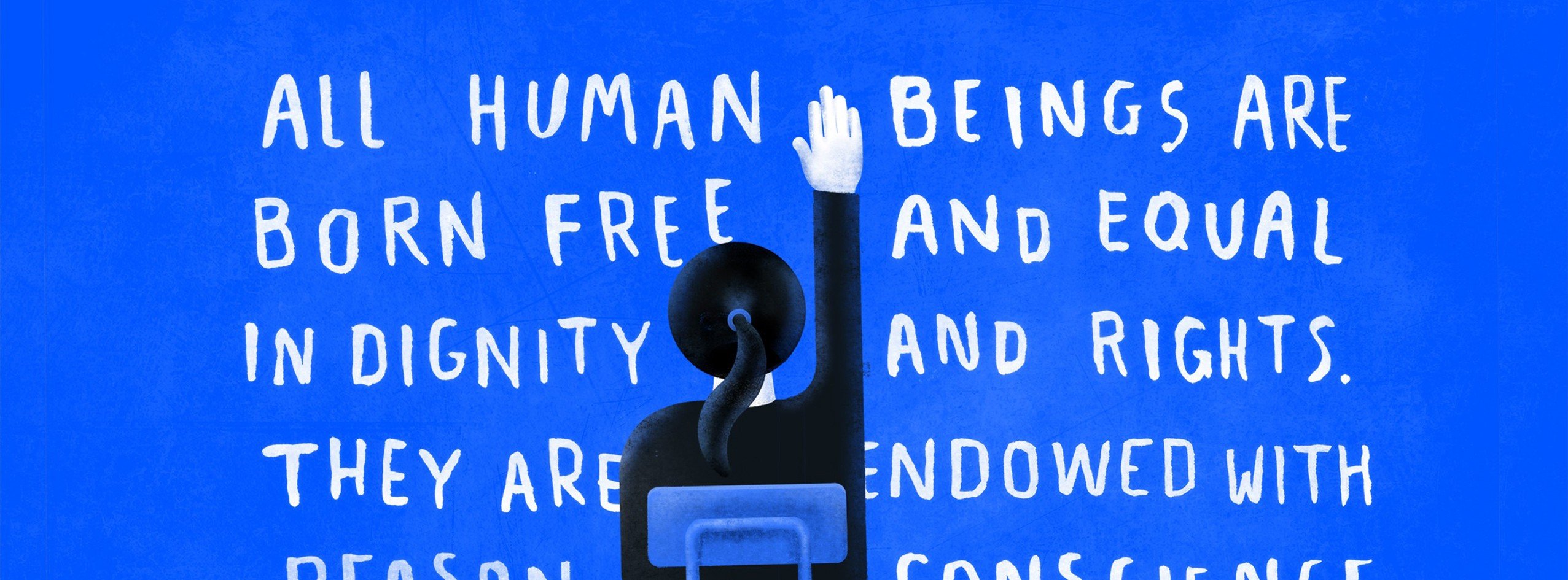
Human Rights Watch (HRW) is an international non-governmental organization headquartered in New York City, that conducts research and advocacy on human rights. The group pressures some governments, policymakers and human rights abusers to denounce abuse and respect human rights and the group often works on behalf of refugees, children, migrants and political prisoners. Human Rights Watch defends the rights of people worldwide. The organisation scrupulously investigate abuses, exposes the facts widely and pressures those with power to respect rights and secure justice. Human Rights Watch is an independent, international organisation that works as part of a vibrant movement to uphold human dignity and advance the cause of human rights for all.
–
What Do They Do?
Investigate: Their researchers work in the field in 100 some countries, uncovering facts that create an undeniable record of human rights abuses.
Expose: They tell the stories of what they found, sharing them with millions of social media and online followers each day. News media often report on their investigations, furthering their reach.
Change: They meet with governments, the United Nations, rebel groups, corporations and others to see that policy is changed, laws are enforced, and justice is served.
–
History
Human Rights Watch began in 1978 with the creation of Helsinki Watch, designed to support the citizen groups formed throughout the Soviet bloc to monitor government compliance with the 1975 Helsinki Accords. Helsinki Watch adopted a methodology of publicly “naming and shaming” abusive governments through media coverage and direct exchanges with policymakers. By shining the international spotlight on human rights violations in the Soviet Union and Eastern Europe, Helsinki Watch contributed to the dramatic democratic transformations of the late 1980s.
Americas Watch was founded in 1981 while bloody civil wars engulfed Central America. Relying on extensive on-the-ground fact-finding, Americas Watch not only addressed abuses by government forces but applied international humanitarian law to investigate and expose war crimes by rebel groups. In addition to raising its concerns in the affected countries, Americas Watch also critically examined the role played by foreign governments, particularly the United States, in providing military and political support to abusive regimes.
In rapid succession in the 1980s, Asia Watch (1985), Africa Watch (1988), and Middle East Watch (1989) were added to what was then known as “The Watch Committees.” In 1988, the organization formally adopted the all-inclusive name Human Rights Watch.
New human rights challenges in the 1990s led to important innovations in the work of Human Rights Watch. It’s reporting on the 1991 Persian Gulf War for the first time addressed violations of the laws of war in bombing campaigns. Advocacy targets were expanded to give greater attention to the United Nations and regional bodies such as the European Union. “Ethnic cleansing” and genocide in Rwanda and the Balkans prompted the need for both real-time reporting of atrocities and in-depth documentation of cases to press for international prosecutions, which became possible for the first time in the 1990s. Human Rights Watch has supported and critiqued the international tribunals for the former Yugoslavia and Rwanda sought prosecutions of abusive leaders including Augusto Pinochet of Chile and Hissene Habre of Chad and played a prominent role in the drafting of the Rome Statute to create the International Criminal Court.
At the same time, Human Rights Watch broadened and strengthened its work on the rights of women, children, refugees, and migrant workers, bringing a human rights perspective to such issues as domestic violence, trafficking, rape as a war crime, and child soldiers. The organization found new ways to investigate rights abuses in closed societies such as Saudi Arabia and North Korea. It helped spotlight previously ignored topics such as the rights of gays and lesbians. It examined the international arms trade and the role of business in human rights, producing ground-breaking studies, for instance, on rights abuses in the oil, gold, and meatpacking industries.
Human Rights Watch in 1997 shared in the Nobel Peace Prize as a founding member of the International Campaign to Ban Landmines, and it played a leading role in the 2008 treaty banning cluster munitions.
The 21st century has brought new challenges. The September 11, 2001 attacks and their aftermath highlighted the need for new forms of pressure on terrorist groups and their supporters and close monitoring of counterterrorism laws, policies, and practices that infringe upon basic human rights. The HIV/AIDS pandemic led to the creation of a Human Rights Watch program devoted to human rights and health.
Human Rights Watch is increasingly applying its research methodology to economic, social, and cultural rights, particularly in the areas of education and housing. Human Rights Watch has also begun using statistical research, satellite photography, and bomb-data analysis, among other new methodologies. Combining its traditional on-the-ground fact-finding with new technologies and innovative advocacy keeps Human Rights Watch on the cutting edge of promoting respect for human rights worldwide.

–
Comparison With The Amnesty International
Human Rights Watch and Amnesty International are the only two Western-oriented international human rights organizations operating in most situations of severe oppression or abuse worldwide. The major differences lie in the group’s structure and methods for promoting change.
Amnesty International is a mass-membership organization. Mobilization of those members is the organization’s central advocacy tool. Human Rights Watch’s main products are its crisis-directed research and lengthy reports, whereas Amnesty International lobbies and writes detailed reports, but also focuses on mass letter-writing campaigns, adopting individuals as “prisoners of conscience” and lobbying for their release. Human Rights Watch will openly lobby for specific actions for other governments to take against human rights offenders, including naming specific individuals for arrest, or for sanctions to be levied against certain countries, recently calling for punitive sanctions against the top leaders in Sudan who have overseen a killing campaign in Darfur. The group has also called for human rights activists who have been detained in Sudan to be released.
Its documentation of human rights abuses often includes extensive analyses of the political and historical backgrounds of the conflicts concerned, some of which have been published in academic journals. AI’s reports, on the other hand, tend to contain lesser analyses and instead focus on specific abuses of rights.
In 2010, The Times of London wrote that HRW has “all but eclipsed” Amnesty International. According to The Times, instead of being supported by a mass membership, as AI is, HRW depends on wealthy donors who like to see the organization’s reports make headlines. For this reason, according to The Times, HRW tends to “concentrate too much on places that the media already cares about”, especially in disproportionate coverage of Israel.
–
Human Rights Watch Annual Expenses
By the Board Members’ instructions, they have compiled the annual account 2018/2019 of the foundation, including the balance sheet with counts of €3,377,378 and the profit and loss account with a positive result of €168,592.
–
References
- https://www.hrw.org/sites/default/files/supporting_resources/hrw_nl_annual_report_2019_0.pdf
- https://www.hrw.org/about/about-us/history
- https://www.hrw.org/about/about-us
- https://en.wikipedia.org/wiki/Human_Rights_Watch
[zombify_post]

0 Yorum